AI Pentest — Autonomous penetration testing
A swarm of specialised agents maps your attack surface, reasons about what it found, chains small weaknesses into a real attack path and exploits it — streaming every decision and tool call live, then delivering a proof-first report you can replay.
What AI Pentest is
A scanner checks individual weaknesses in isolation. A human pentester does something harder: they reason — combining small issues into a real attack, pivoting from one foothold to the next and proving impact. AI Pentest brings that approach to CodesGuard with autonomous agents that plan, choose and run security tools, and adapt based on what they find. It answers the question a checklist can't: “What would a real attacker actually be able to do here?”
A real kill chain
Recon, discovery, analysis and exploitation — each phase closes on evidence, never a timer.
Live reasoning stream
Watch the swarm think, pick tools, run them and change plans as results come in.
Proof-first findings
A proven finding carries the request/response pair, the chain of steps and a reproduction command.
The kill chain
A run moves through five phases. Crucially, each phase closes when its evidence is complete — never on a timer — and the swarm hands off to the next phase only on what it has actually proven:
- Reconnaissance
Surface mapping, DNS and certificate sweeps and technology fingerprinting — building a picture of what's actually exposed.
- Content discovery
Endpoints, parameters and JavaScript analysis — finding what the spec and the UI don't mention.
- Vulnerability analysis
Authentication, injection and business-logic probes against every discovered parameter.
- Exploitation
Small weaknesses chained into a proven attack path — one record touched, logged and attached as evidence.
- Reporting
Verified findings, closing evidence for each phase and a downloadable report.
How it differs from DAST
DAST and AI Pentest both test a running system, but they think differently:
| DAST | AI Pentest | |
|---|---|---|
| Approach | Automated scanner — broad, systematic checks. | Autonomous agents — reason, chain and exploit. |
| Strength | Breadth and repeatability. | Depth: multi-step attacks a scanner won't find. |
| Output | Vulnerabilities with evidence. | Proven, chained exploits with a reasoning trail. |
| Best for | Regular coverage of the attack surface. | Understanding real-world exploitability. |
They're complementary: run DAST for continuous coverage and AI Pentest when you want to know how far an attacker could actually get. Run both.
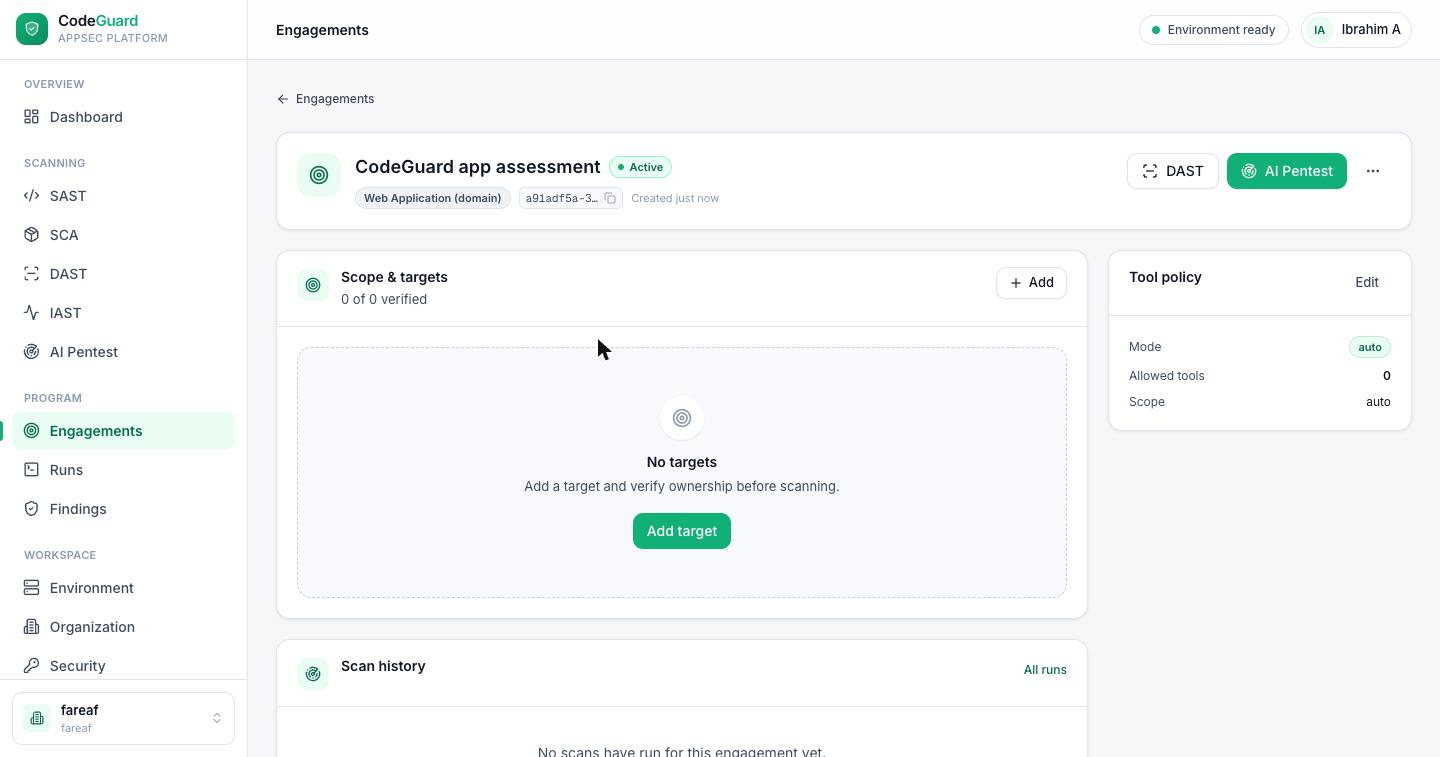
Before you run: you need an engagement
Like DAST, AI Pentest runs against a DNS-verified target on an engagement, so it inherits the same authorization and scope. Set up the engagement once (create & attest → add & verify targets → optionally capture a login) and you're ready to launch. Attach a captured login if you want the swarm to test behind authentication.
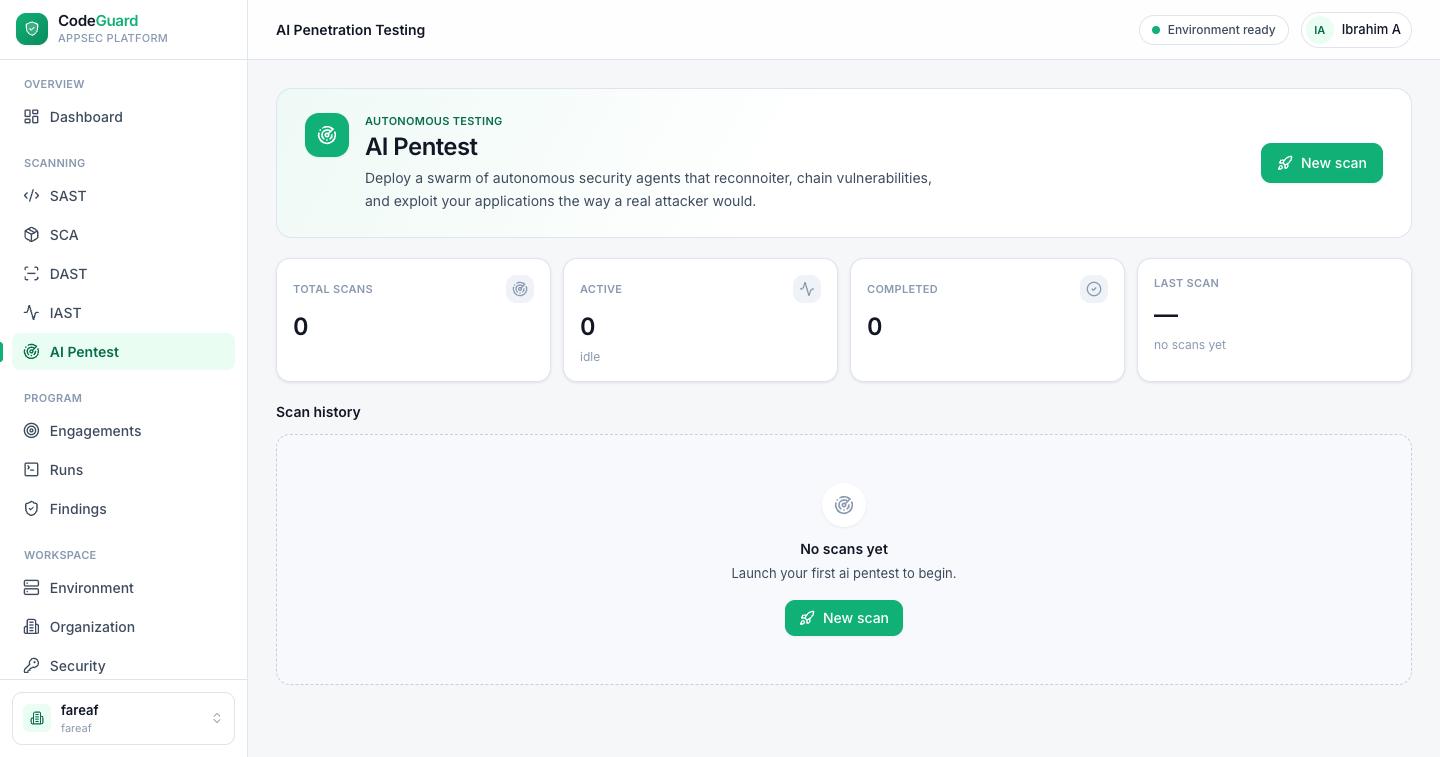
Launching a run
- Pick the target
Choose an engagement and a verified target. Attach a captured login if you want the swarm to test behind authentication.
- Launch
There's no depth selector — the agents adapt their approach as they go and hand off between phases only on evidence.
- Follow the stream
The run view shows reasoning, tool calls and findings as they're proven, phase by phase.
- Read the report
Proven findings with evidence, the attack chains, closing evidence per phase, and a downloadable report.
A full offensive toolkit
The agents draw on reconnaissance, fuzzing, injection, secret-discovery and exploitation tooling — dozens of capabilities they choose from based on the target in front of them. You don't configure the toolkit; the swarm selects what each situation calls for and records every tool call in the stream.
Reading results — proof-first
AI Pentest is proof-first: rather than flag a theoretical issue, it aims to demonstrate the exploit and attach the evidence. A proven finding carries the request/response pair, the chain of steps that led there and a reproduction command; suspected issues that couldn't be proven are labelled as such, so you always know what's demonstrated versus what's a lead. Findings appear in the unified Findings view and roll up into your dashboard posture, and you can replay the full run from the Runs page at any time.
Safety rails
Profiles
The depth of a run is set by its profile, which maps to your plan:
| Profile | Plan | What it does |
|---|---|---|
| Recon | Free trial | Surface mapping only — recon tooling, no exploitation, a handful of delegations. |
| Standard | By arrangement | The full kill chain with the standard tool tier and up to 15 delegations per run. |
| Deep | Enterprise | Extended exploitation: the deep tool tier, exploit suggestions, up to 50 delegations and 20 stage revisits. |
Access & plans
AI Pentest is available on the Trial (Recon profile) and Enterprise plans, typically with a quota on runs and a ceiling on run duration and monthly run minutes. If it isn't in your plan, the module shows an upgrade prompt — see Billing & plans. Runs require a healthy tenant stack; see Environment.
FAQ
- How is this different from DAST?
- DAST runs broad, systematic checks and is great for regular coverage. AI Pentest reasons: it combines small issues into a real attack, pivots from one foothold to the next and proves impact. Run both.
- Is it safe to point at production?
- Every run sends real attack traffic, so CodesGuard requires an authorization attestation and DNS-ownership verification first. Tool policy and scope bound the run, destructive actions are blocked, and the agent stops after one proof.
- How long does a run take?
- As long as the work takes. Phases close when their evidence is complete, and you can cancel at any time. Your plan sets a ceiling on run duration and monthly run minutes.